You search your own service and your own city. A row of three businesses pops up at the top of the results, map pins and all. Your business isn't one of them. You have a real storefront, a working website, happy customers. None of that seems to matter to whatever decided who gets that spot.
That row of three is called the map pack, or local pack, and it's one of the most valuable spots in local search. Most people never scroll past it. Whether you show up there comes down to three factors Google itself names publicly: proximity, relevance, and prominence. If your business is missing, the reason usually traces back to one of those three, and it's often not the one owners assume.
The three factors, in plain terms
Proximity is distance. Proximity is the physical distance between the searcher and the business; the closer the business is to the searcher's location, the more likely it is to appear in results. This is the one factor you can't control, since you can't move your building closer to every searcher. There isn't much a business can do to target proximity directly, but your Google Business Profile and other listings still need an accurate name, address, and phone number.
Relevance is the match between what someone searched and what your listing says you do. Google defines relevance as how well a local Business Profile matches what someone is searching for, and it works like a filter before anything else gets weighed. This is where a lot of businesses quietly lose ground without noticing. If your primary category on your profile is generic, or your listing doesn't mention the specific service someone searched for, you get filtered out before proximity or prominence even factor in. A broad category for a specific, searched-for service tells Google you're less relevant for that search.
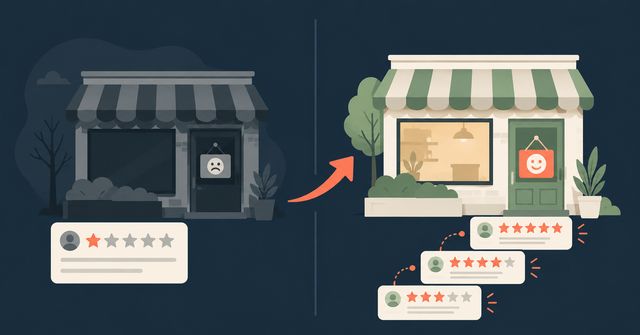
Prominence is reputation, both online and off. Prominence measures how well-known and reputable a business is, and for local search rankings Google relies heavily on a business's Google reviews to evaluate it.
Businesses with more reviews and a strong average score are more likely to rank higher, while businesses with fewer reviews and lower scores tend to rank lower. This is the factor most within a business owner's control, and it's also the one that's grown more important over time.
Reviews are carrying more of the weight than they used to
Local search ranking surveys track how much weight each category of factor carries in local pack results, and the shift in recent years is clear. Reviews have grown in importance for local pack rankings, moving from 16% in 2023 to 20% today (a 25% increase), while on-page ranking factors have fallen for both local pack and local organic results in the same period according to BrightLocal.
Google doesn't just count stars. It looks at review frequency and recency, giving more weight to newer reviews when evaluating a business's prominence. A business with 80 reviews from three years ago and nothing since can rank behind a competitor with 40 reviews, half of them from the past two months. In local ranking, a steady, unglamorous habit like asking recent customers for a review after the work is done, does more for visibility than almost anything else a small business can do on its own.
The overlooked factor: hours
Hours are a ranking input many owners miss. Business hours act as a relevance signal, and businesses that are open when a user performs a search are more likely to show up in those results and rank higher than those that are closed.
In some cases rankings drop off altogether when a business is closed. If your listed hours don't match reality, or you're closed for a slow midweek stretch and haven't updated your profile, you may be invisible at the exact moments people are searching.
Categories and service pages carry more weight than they appear to
Relevance isn't decided by your business name alone. It's decided by the specific category you've chosen on your Google Business Profile and whether your website has a dedicated page describing the exact service someone searched for, not just a general "services" page that mentions it in passing. A business offering several distinct services under one roof benefits from a separate page for each one, built around the language a customer would type into a search bar.
Map pack fundamentals are also becoming the foundation for AI-driven recommendations
The same underlying data (your profile completeness, your categories, your review volume and recency)is increasingly what AI tools draw on when someone asks for a recommendation instead of typing a search. AI visibility depends on many of the same signals that drive traditional local SEO rankings, with more weight on structured, consistently referenced business data, and AI systems favor businesses that look real, active, and consistently referenced across multiple sources.
Getting the map pack fundamentals right isn't a separate project from showing up well when someone asks an AI assistant instead. It's the same foundation, built once.
What to check first
Start with the profile itself: is your primary category the most specific one available, or a generic catch-all? Do your business hours match what's posted on your door? Do you have a steady, recent flow of reviews, or a pile of old ones with nothing new in months? Does your website have a page for each service you offer, written the way a customer would search for it, rather than one page trying to cover everything? Each of these is fixable without touching a line of code, and each one maps directly to one of the three factors Google names as deciding who shows up.
Key Takeaways
- Google's local map pack rankings come down to three named factors: proximity, relevance, and prominence, and most visibility problems trace to relevance or prominence rather than distance.
- Review volume and recency carry more ranking weight than they used to, and old reviews with no recent activity can hold a business back even with a high average rating.
- Business hours function as a relevance signal, and a business can rank lower or disappear from results if it's marked as closed when the search happens.
- A generic business category or a single catch-all services page weakens relevance for the specific searches that bring in customers.
- The same profile, review, and consistency signals that drive map pack rankings are becoming the foundation for how AI tools decide which local businesses to recommend.
If your business isn't showing up in the map pack, the fix usually starts with the profile and reputation signals behind it. Mindstate Strategy handles Google Business Profile optimization and reputation management for businesses across San Diego County, and you can use the contact page to request a review of your current listing.